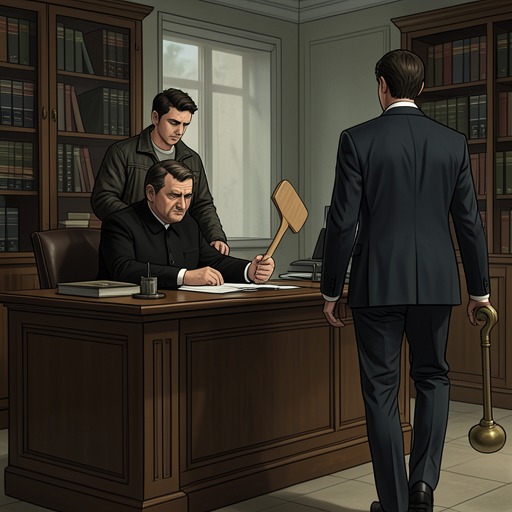
Statenville
Dead ShotStatenville is both the physical setting and the governing system of the novel: a small Idaho town whose apparent prosperity and calm are sustained by concealed coercion. Its decisive significance lies in the contrast between the town’s brisk public normality and the violent machinery protecting its “dark secret.” What first appears to be an isolated provincial assignment for reporter Cal Murphy becomes an investigation into how a community can turn economic success, local government, law enforcement, and public silence into mutually reinforcing instruments of control.
Prosperity and Public Normality
Statenville is introduced through Cal’s resentment at being trapped there. He had dreamed of covering the Mariners for The Seattle Times, but the only position he could obtain was a general-assignment reporting job at The Register in Statenville, Idaho. Josh’s mockery of the town as a place where “no real news ever happens” expresses its public reputation: remote, uneventful, and professionally limiting. Cal’s best published work is reduced to an article about little-league tournament champions, a symbol of the modest scale of ordinary news in the town.
Yet the town is not economically dormant. When Cal looks down Main Street, he sees shoppers and business owners moving through Statenville’s usual brisk activity. Many of them are people he knows, and they continue with business as usual even while a killer may be operating among them. The crucial question is not simply why the residents are uninformed, but why no one seems frightened. The normal commercial rhythm therefore becomes evidence in its own right: Statenville’s prosperity has produced a social habit of looking away, or at least of behaving as if looking away were necessary.
That prosperity is closely associated with Cloverdale Industries, described as Statenville’s major export business and the force turning the town into a boomtown while neighboring communities struggle in a weak economy. The success gives Mayor Nathan Gold political cover. Residents can treat his decisions as visionary because the town appears to be thriving, and material improvement makes challenges to local authority seem imprudent or even disloyal. Statenville’s economic success is thus not merely background scenery; it is the public justification for the arrangements that govern it.
Government and Law Enforcement
The town’s institutional structure was reshaped by Gold when he first became mayor twelve years earlier, at a time when “recession” had rarely influenced local decision-making. Gold masterminded the joint consolidation of the Statenville Police Department with the Brooks County Sheriff’s Department. The merger eliminated officers considered unnecessary in a largely law-abiding town while concentrating resources and authority in a city-county law-enforcement department. The arrangement made Gold popular and allowed supporters to call him a visionary, even as critics regarded him as controlling.
Sheriff Hunter Jones benefits directly from that consolidation. He is not complaining about the merger because it gives him more assets and more control. The same institutional efficiency that looks sensible in public therefore increases the reach of a sheriff who can manage information as carefully as he manages personnel. When Cal and Kelly ask about the deaths of three young men, Jones insists that the victims died from simple drug overdoses and resists treating the circumstances as murders. He frames suspicion as insufficient for a conviction, but his insistence on the overdose narrative precedes the toxicology results that could establish it.
Jones also controls the flow of preliminary evidence. He tells the reporters that methamphetamine was found at all three scenes, then immediately retreats behind the claim that official knowledge will not be available until toxicology reports return from Boise, perhaps two weeks later. The tactic offers a usable fragment of information while blocking the questions that might connect the deaths. Later, when Kevin Mendoza indicates that the victims may have bled to death rather than overdosed, the order is reversed: the toxicology screens are canceled, and the overdose conclusion is imposed before the tests can challenge it. In Statenville, law enforcement does not simply investigate evidence; it determines which version of evidence can exist.
The town’s routine legal process becomes another instrument of pressure. After Cal draws close to the concealed truth, he is arrested on charges of possessing an open container and driving under the influence. He knows the accusations would not survive a genuine court proceeding: he rarely drank, had not been driving with alcohol in the car, and had no open container. Nevertheless, he recognizes the arrest as an intimidation tactic. Jake Dawkins books him, takes his mug shot, and mocks him throughout the process, while Cal is left unsure where to find a lawyer in a town whose limited attorneys are unavailable to him. The arrest changes Statenville from the place where he works into the mechanism actively imprisoning him.
The Secret Behind the Calm
The three deaths expose the gap between Statenville’s official story and its underlying structure. The victims are three teenage athletes, and Jones presents their deaths as coincidental drug overdoses despite their occurrence within a twenty-four-hour period. Cal and Kelly see the pattern as too suspicious to dismiss, while the town’s officials treat the pattern as something to be contained through terminology, delayed reports, and controlled access to information.
Gold’s private response reveals that Statenville’s stability is maintained through more than persuasion. He has dealt with snooping citizens, disgruntled employees, and curious trespassers by offering money or displaying a handgun; people who encounter those measures often develop what the narrative calls an immediate case of amnesia. For those who cannot be persuaded, he maintains an unused rocky quarry in a secluded canyon. The town’s peaceful reputation therefore rests beside a disposal system designed for anyone who threatens it.
Cloverdale Industries reinforces the system through an employee secrecy policy backed by fear. Gold conducts rigorous “background checks” on new employees and even investigates existing workers because everyone is understood to share a sacred secret. Disclosure would cost them their well-paid jobs and could send them to federal prison. Gold repeatedly emphasizes those consequences at closed corporate gatherings, making secrecy appear both a condition of employment and a form of collective self-preservation.
The system is not perfect. Buddy Walker, who presents himself as a basketball coach seeking a few hours of work to help support his elderly mother, passes Gold’s screening despite several ordinary encounters with the law. Gold finds nothing that suggests Walker is not what he claims to be, but Walker is in fact connected to a federal investigation and has been working with another agent. Gold recognizes this as a nightmare scenario because an undercover federal presence has access to every room at Cloverdale Industries. His fear is not only exposure of the company; it is the collapse of the entire arrangement that allows Statenville to appear prosperous.
Gold’s thoughts also strip away his public justification. He tells himself that eliminating threats protects Statenville from becoming another rural ghost town in a failing economy, but he admits that his actions are not really about the town or its people. The town’s welfare is the language he uses to defend a structure built around his own power. That distinction matters: Statenville’s corruption is not an accidental deviation from civic duty but a deliberate substitution of private control for public good.
Flight, Retaliation, and Exposure
Once Cal and Kelly understand that the official account cannot be trusted, Statenville becomes a landscape of pursuit. Kelly’s red 2010 Dodge Charger carries them away from The Register’s back alley after their encounter with Jones, with both front windows down and apprehension replacing the flirtatious atmosphere Cal might otherwise have enjoyed. Their movement out of the newsroom marks a shift from reporting inside the town’s institutions to evading those institutions.
The pursuit continues through fabricated charges and coordinated local enforcement. Jones directs Dawkins and rookie deputy Willie Warren toward Walker’s house after learning that Cal and Kelly are there, presenting the call as a disturbance while concealing that the reporters are the actual targets. Dawkins is told they are Statenville’s hottest fugitives and that they are to be arrested on more trumped-up charges. Warren approaches with his gun unholstered so the fugitives will understand the seriousness of the threat, even though the officers have no reason to believe the situation is dangerous.
The town’s reach extends beyond its own borders. When Cal and Kelly try to place their story with Dave Youngman, they are told that the newspaper cannot run it. Without the protection of the press, Cal understands that even returning to life in Statenville may be impossible. The refusal is a value shift from the promise that journalism can protect truth to the recognition that media institutions may also retreat when the costs of publishing become dangerous. Cal nevertheless refuses to let the rejection defeat him.
The danger finally becomes explicit when someone attempts to kill Cal and Kelly, possibly more than once or through more than one group. Kelly warns that the town may be capable of killing anyone who possesses enough evidence, and Cal understands that the investigation has moved beyond a local story. If proof can be secured, Statenville may become the center of a national media frenzy: the twenty-first-century version of a gold rush, this time driven by a compelling story involving a government conspiracy. The possibility of national exposure threatens the town’s local system because its power depends on controlling information within a limited community.
At the cliffside confrontation, Gold approaches the handcuffed reporters with their backs fifteen yards from the edge. He calls them “the two burrs in my saddle” and says he intends to crush them himself. Cal responds by following a script, pretending that his only concern was discovering what killed Gold’s son and that he had not realized doing his job made him such a persistent irritation. The exchange turns Gold’s private metaphor into an indictment of his rule: journalists are dangerous to him not because they have committed crimes, but because they keep probing where the town’s authorities insist no questions should be asked.
Narrative Significance
Statenville’s narrative function is built on a sustained reversal. It begins as the place where no real news happens and becomes the place where every ordinary civic category—death, evidence, employment, law enforcement, prosperity, and public safety—has been compromised. The town’s visible normality is not disproved by its hidden violence; it is produced by that violence. Shoppers continue along Main Street, businesses remain active, and officials speak the language of efficiency because the institutions capable of disrupting the appearance of order have been absorbed into the order itself.
The town also gives Cal a position from which to see the corruption. As a reporter who feels professionally stranded, he initially experiences Statenville as a career dead end, especially in comparison with Josh’s advancement at The Seattle Times. Once the deaths occur, however, his marginal status becomes a form of freedom. He is not invested in protecting the town’s reputation, Cloverdale Industries, or the political achievements attributed to Gold. His frustration with Statenville becomes the vantage point from which its contradictions can be read.
Statenville therefore operates as more than a small-town setting. It is a compact model of systemic corruption in which economic dependence legitimizes political control, consolidated policing concentrates discretionary power, evidence is managed before it can become knowledge, and violence waits behind the rhetoric of community welfare. Its central secret is protected not by one lie alone, but by a whole civic environment in which prosperity makes silence appear reasonable and truth-telling appear destructive. The investigation’s stakes become so large because exposing Statenville means exposing the bargain beneath its calm: the town has been allowed to prosper, but only within the boundaries set by those who control what its people are permitted to know.